


17 Aug Cast Iron Plumbing on Oahu: What Homeowners in Older Homes Need to Know
If your home was built before 1975 — and a significant portion of Honolulu’s housing stock was — there’s a good chance your drain, waste, and vent system is made of cast iron pipe. It’s been doing its job quietly inside your walls and under your floors for decades. You’ve probably never thought about it.
That’s about to change.
Cast iron plumbing installed in the 1950s, ’60s, and early ’70s is now 50 to 75 years old. On the mainland, in a dry climate, cast iron might reach the upper end of its lifespan. On Oahu, it’s different. Humidity, salt air, acidic soil, and our local water chemistry combine into one of the most corrosive environments a pipe can live in — so those timelines shrink. Systems that might have lasted another decade elsewhere are failing here now.
This post is for homeowners in older Honolulu neighborhoods — Kaimuki, Manoa, Nuuanu, Palolo, Makiki, Pacific Heights, Salt Lake, Aina Haina, and similar communities — who want to understand what they’re dealing with, what to watch for, and what their options are when cast iron starts to go.
What Cast Iron Pipe Actually Is — and Why It Was Used
Cast iron is exactly what the name says: iron melted and poured into molds to form pipe sections. It was the standard material for residential and commercial drain, waste, and vent (DWV) systems for most of the 20th century, and for good reason. Cast iron pipe is heavy, dense, and extremely durable when new. It handles the full range of drain demands — waste flow, thermal cycling from hot water, and the pressures of a multi-story home — without the brittleness that affects lighter plastic alternatives.
It also dampens sound well. If you’ve ever been in an older home and noticed how quiet the drains are during use, that’s cast iron at work. Modern ABS and PVC plastic transmits sound much more readily, which is why homes repiped with plastic sometimes feel noisier than they did with the original cast iron in place.
Cast iron’s use in residential plumbing declined sharply in the mid-1970s, when ABS plastic became widely accepted by building codes. ABS is lighter, less expensive, faster to install, and doesn’t corrode. For new construction, the choice was clear. But the cast iron already in the ground — in millions of homes across the country, and in thousands of homes right here on Oahu — stayed in service. Most of it still is.
How Cast Iron Plumbing on Oahu Fails: The Process, Not Just the Result
Cast iron doesn’t fail the way supply pipes do — with a sudden, dramatic burst. It fails gradually, through a process that’s been happening inside your walls and floors for years before you notice anything at the surface.
The main way it fails is corrosion from the inside out. Drain lines carry waste water and organic material. As that material breaks down, it naturally gives off hydrogen sulfide gas. In Hawaii, salt-laden air and moisture from outside get into the mix too. When that gas meets moisture, it turns into sulfuric acid, which eats at the iron pipe wall from the inside. Plumbers call this microbiologically influenced corrosion, or MIC. It’s slow, but relentless.
At the same time, Hawaii’s acidic soil works on the pipe from the outside, especially on buried runs. Our volcanic soil has a lower pH than typical mainland soil, and that speeds up external corrosion on cast iron.
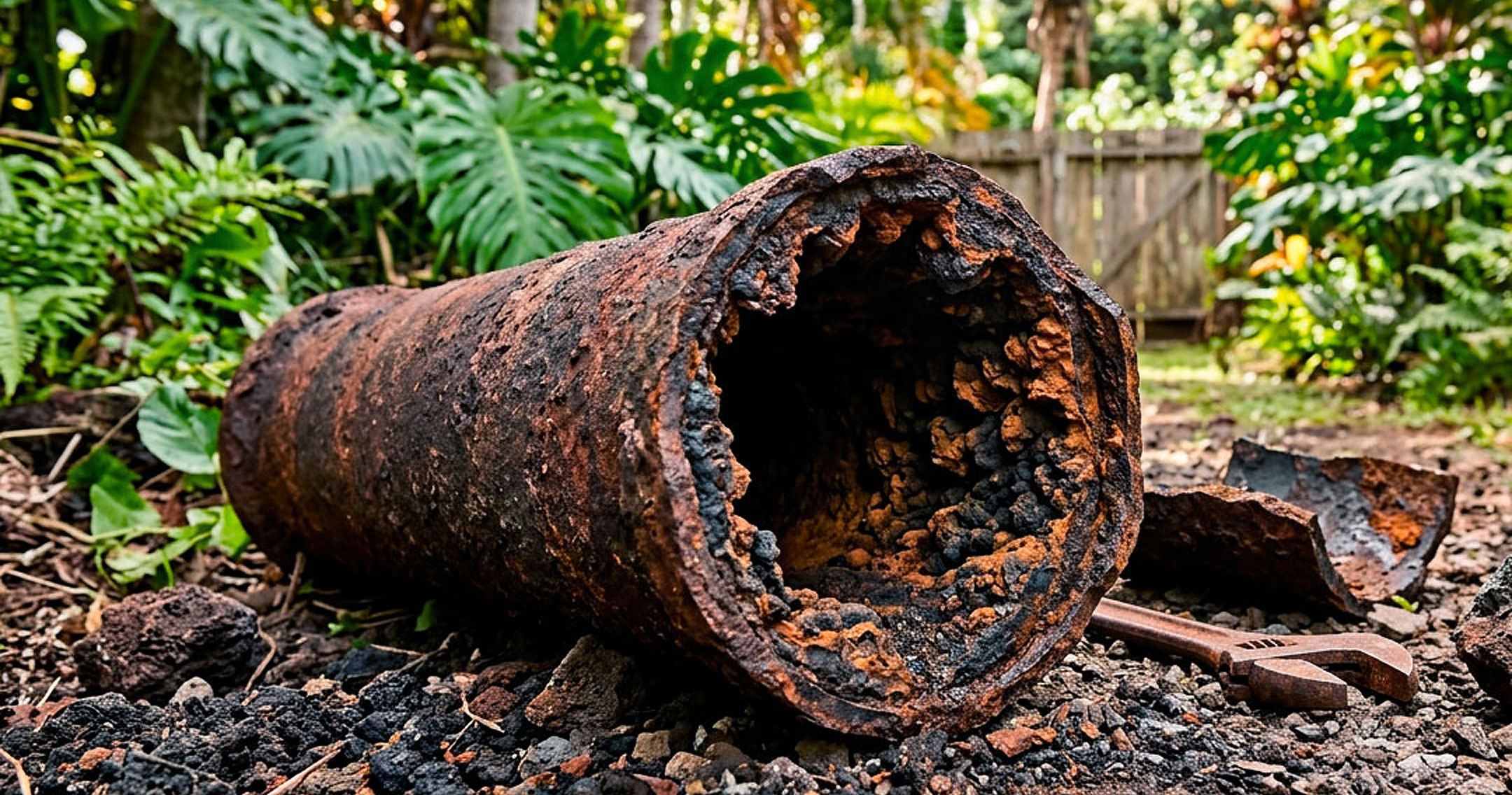
Over the decades, the pipe steadily loses wall thickness. A cast iron pipe that started out around 3/8 inch thick can wear down to paper-thin spots after 50-plus years in Hawaiian ground. Those spots start to weep — tiny cracks and pinholes that let moisture, and eventually waste, seep through. From there it can progress to cracks, separated joints, and, in the worst cases, a fully collapsed section.
Tuberculation is another problem specific to cast iron. As the wall corrodes, rust deposits build up on the inside surface. These form rough, uneven bumps that shrink the usable width of the pipe. A 4-inch drain can end up flowing like a 2- or 3-inch line. It’s why older homes often have slow drains and repeat clogs even when there’s no obvious blockage — the inside of the pipe is simply much smaller than it used to be.
Why Oahu Is Harder on Cast Iron Than the Mainland
Mainland plumbers working on older homes will sometimes quote cast iron lifespans of 75 to 100 years. On Oahu, we tell homeowners to think in the range of 50 to 70 years — and in some neighborhoods and soil conditions, even less.
| Location | Typical cast iron DWV lifespan |
|---|---|
| Mainland (drier climate, often alkaline soil) | 75–100 years |
| Oahu (humidity, salt air, acidic soil) | 50–70 years, sometimes less |
Several factors stack against cast iron specifically in Hawaii:
| Factor | How it attacks cast iron |
|---|---|
| Volcanic, acidic soil | A lower pH than most mainland soil — especially near the Koolau and Waianae ranges — speeds up external corrosion on buried pipe. |
| Year-round humidity | Corrosion needs moisture. Constant humidity keeps pipe exteriors — even in crawl spaces and under-building areas — almost never truly dry, which speeds oxidation. |
| Coastal salt air | Homes within a mile or two of the coast (much of Honolulu) get salt-laden air that works into building cavities and speeds metal corrosion. |
| Grease-heavy drain use | Oils and fats build up in drain lines and feed the microbes that produce hydrogen sulfide — which drives internal corrosion. |
Warning Signs You Shouldn’t Ignore
Cast iron deterioration is gradual, but it does send signals. Homeowners who know what to look for can catch problems before they become emergencies.
| Warning sign | What it often points to |
|---|---|
| Slow drains throughout the house — not just one fixture | A restriction in the main line itself, often tuberculation narrowing the cast iron. (One slow fixture is usually just a local clog.) |
| Gurgling from drains or toilets | Air trapped in a partly blocked or deteriorating line — like a toilet that gurgles when you run the kitchen sink. |
| Sewer or “rotten egg” smell indoors | Cracks or joint separation letting sewer gas escape. In enough concentration, hydrogen sulfide is a health hazard — take it seriously. |
| Clogs that keep coming back within months | The pipe’s interior condition, not a removable clog — a rough, corroded surface catches debris again and again. |
| Rust staining or damp at floors and walls | A slowly leaking cast iron joint — often a slow seep near a toilet, cleanout, or the base of a wall rather than a dramatic leak. |
| Soft spots or settling in floors | A long-term leak under a slab or subfloor washing out the material beneath — sometimes showing up as tile cracking in a bath or kitchen. |
Any one of these in a pre-1975 home is worth a closer look. Several of them together is a strong signal to have the drain line inspected.
Repair, Reline, or Replace? Understanding Your Options
When cast iron reaches the point of needing attention, Oahu homeowners generally have three paths forward. Which one makes sense depends on how much of the system is deteriorating, and where.
Spot Repair
If a camera inspection finds one or two isolated problems — a cracked section, a separated joint, a small weeping area — a targeted spot repair may be enough. The plumber cuts out the bad section, splices in a compatible coupling and new pipe, and restores service. It’s the least disruptive and least expensive option when the rest of the system is in reasonable shape.
The limitation: spot repair treats the symptom, not the trend. If your cast iron is 60-plus years old and failing in one place, the surrounding pipe is probably in similar shape. A spot repair can buy time, but it’s rarely the final answer for system-wide deterioration.
Pipe Lining (Trenchless Rehabilitation)
Pipe lining — also called CIPP, for cured-in-place pipe — puts a resin-soaked liner inside the existing cast iron and cures it in place, forming a new pipe within the old one. The cast iron stays where it is; the liner becomes the new flow surface. It’s especially useful when:
- The pipe runs through or under a slab foundation, a tiled bathroom floor, or finished living space, where physical replacement would mean major demolition
- The pipe structure is intact but the inside is corroded, scaled, or lightly cracked
- Keeping disruption to a minimum is a priority
Lining shrinks the inside diameter slightly, but for most homes the reduction is small enough to keep full flow. It also solves the corrosion problem by sealing the cast iron off from the waste stream entirely — the epoxy liner resists the sulfuric-acid environment that eats iron.
535 Plumbing offers cast iron pipe lining and relining, and in many Oahu homes with accessible but deteriorating cast iron, it’s an excellent middle path between spot repair and full replacement.
Full Replacement
When a camera inspection shows widespread deterioration — heavy tuberculation, several cracked sections, joint failures in multiple places — full replacement is the most practical long-term fix. The cast iron is removed and replaced, usually with ABS plastic drain pipe, the current standard for residential DWV systems, which doesn’t corrode.
Full replacement is more disruptive and more expensive than lining or spot repair, but it resets the clock entirely. A properly installed ABS drain system has an expected service life of 50 to 80 years and needs none of the ongoing upkeep aging cast iron demands.
If you’re planning a kitchen or bathroom renovation, full cast iron replacement is often worth doing at the same time — the walls and floors are already open, which sharply lowers the labor cost of reaching the drain system.
Camera Inspection and Descaling: Know Before You Decide
Before any of these decisions can be made intelligently, you need to know what you’re actually dealing with. A camera inspection — a waterproof camera on a flexible cable fed through the drain line — is the only way to see the real condition of the pipe interior: wall thickness, tuberculation buildup, crack locations, joint condition, and any root intrusion.
Without a camera inspection, you’re guessing. With one, you have a documented baseline of your system’s condition and a clear picture of what action — if any — is needed, and where.
For cast iron that’s deteriorating but not yet failing, descaling can extend the system’s useful life significantly. It removes tuberculation and mineral buildup from the pipe interior using mechanical chain knockers or hydro jetting, restoring closer to the original flow and clearing the rough buildup that drives future clogs. Descaling is maintenance, not a repair — it won’t fix cracks or rebuild corroded wall — but paired with pipe lining, it can rehabilitate an aging cast iron system effectively.
535 Plumbing offers both camera inspection and descaling, and we can tell you whether your cast iron is a candidate for rehabilitation or whether replacement is the more practical path.
Buying a Pre-1975 Home on Oahu? Inspect the Cast Iron First
Cast iron plumbing is one of the items we most strongly recommend checking before you close on a pre-1975 home in Honolulu. The condition of a cast iron drain system isn’t visible from the surface, and it’s rarely caught in a standard home inspection. A general inspector can note that cast iron is present; they can’t tell you whether it’s in good shape or nearing failure without a camera inspection.
Requesting a plumbing camera inspection as part of your due diligence is one of the highest-value things you can do. It costs a fraction of a drain-system replacement, and it gives you real information about a system you’d otherwise inherit blind.
If the inspection turns up problems, that information has value — as a negotiating point on price, as grounds for the seller to fix it before close, or simply as a known cost you can plan for.
We’re Here to Help
As a licensed and insured Oahu plumbing company that’s served the island since 2015, we work with cast iron plumbing every week. We’ve done camera inspections in Manoa cottages, descaling in Kaimuki apartment buildings, pipe lining under Makiki slab foundations, and full DWV replacements in Aina Haina homes mid-renovation. We know what Hawaii cast iron looks like at 50, at 60, and at 70 years old — and we’ll give you an honest read on where yours falls.
If your home is pre-1975 and you’ve never had the drain system looked at, or you’re seeing any of the warning signs above, it’s worth a conversation. If it’s fine, we’ll tell you that too.
📞 Call us at (808) 300-0535. Serving homeowners across Oahu — from Kaimuki and Manoa to Ewa Beach, Kailua, and Mililani.
Frequently Asked Questions
How do I know if my home has cast iron pipe?
The most reliable way is a plumbing camera inspection. Visually, cast iron is heavy, dark gray to black, with a dull matte surface — unlike the shiny silver of galvanized steel or the white or black of plastic. It’s also much heavier than any plastic pipe. If your home was built before 1975 and the drains have never been repiped, cast iron is likely present.
My drains work fine. Do I still need to worry about cast iron?
Working drains don’t mean the pipe is in good condition — only that it hasn’t failed obviously yet. Moderate tuberculation and early-stage corrosion can be present for years before you notice slow drains. A camera inspection is the only way to know the pipe’s real condition without waiting for a problem to surface.
Can cast iron pipe be repaired rather than replaced?
Yes, in many cases. Spot repairs and pipe lining are both viable options depending on the condition and location of the deterioration. Full replacement isn’t always necessary — the right recommendation should come from what a camera inspection actually shows, not a default toward the most expensive option.
How long does cast iron pipe last on Oahu?
In Hawaii’s climate and soil, cast iron typically lasts 50 to 70 years before it needs serious attention — sometimes less in aggressive soil or with heavy use, sometimes more in favorable conditions. Homes built from the late 1950s through the mid-1960s are squarely in the window where proactive inspection makes sense.
What replaces cast iron when it’s removed?
Standard practice today is to replace cast iron DWV systems with ABS (acrylonitrile butadiene styrene) plastic pipe, which is lightweight, durable, corrosion-resistant, and code-approved for residential drain, waste, and vent applications in Hawaii. It doesn’t corrode, doesn’t tuberculate, and has an expected service life of 50 to 80+ years.
Is there any benefit to keeping cast iron rather than replacing it with plastic?
Acoustic dampening is the main practical benefit — cast iron is significantly quieter than ABS or PVC for drain noise. Some homeowners doing renovations choose to keep accessible cast iron sections that are in good condition and replace only the deteriorated sections, keeping the quiet while addressing the problem areas. A plumber can help you weigh whether a hybrid approach makes sense for your situation.
Mahalo for reading!
Why Choose 535 Plumbing
We’re not just a service company — we’re your neighbors. We know Oahu’s plumbing codes, water chemistry, and the corrosion patterns specific to your zip code. From CIPP lining and trenchless sewer line repair in Hawaii to tankless water heater installation and routine residential work, we bring commercial-grade expertise to every home.
Schedule an inspection or call us to talk through your situation. We’re here to help!
Membership Programs Bring Peace Of Mind
Aloha Membership Preventive Plumbing Maintenance
Our Aloha Membership is designed for homeowners who want year-round peace of mind. It includes routine plumbing inspections and maintenance that help catch issues early — before rainy season turns them into emergencies. Preventive care is one of the best ways to avoid unexpected plumbing repairs.
Annual Backflow Inspection Membership
535 Plumbing’s Annual Backflow Inspection Membership ensures regular testing and inspection of your backflow devices, preventing contaminants from entering the potable water supply and protecting your family’s health. It helps identify and repair issues before they lead to costly system failures or water contamination events.
Annual Tankless Water Heater Maintenance Membership
Our Annual Tankless Water Heater Maintenance Membership ensures regular testing and inspection of your tankless water heater, removing scale buildup, ensuring a reliable supply of heated water, and preventing costly repairs and extending the unit’s lifespan.
All Membership Plans include:
- 10% off on all services, up to $600.
- Service coordination fees waives, a $139 savings on every service visit.
- Priority Scheduling, placing you at the top of the list.
Let us help you prepare, protect, and prevent plumbing problems before they cause greater damage and larger repair costs.
Why Local Experience Matters
Plumbing in Hawaiʻi is different from plumbing on the mainland. Our soil, weather, tree growth, and older infrastructure create unique challenges. That’s why working with a local plumbing company that understands Hawaiʻi conditions makes a big difference.
At 535 Plumbing, we’ve helped homeowners across the islands deal with plumbing issues for years. We don’t believe in scare tactics — we believe in honest inspections, clear explanations, and solutions that make sense for your home and budget.
Start the new year with confidence. Call (808) 300-0535 to schedule your plumbing inspection today. Hiring a licensed plumber ensures the job is done correctly and up to code.
Call 535 Plumbing for Expert Advice
Whether you choose to repair or remodel, 535 Plumbing can help you make the right decision for your home and budget. We provide honest recommendations, professional installation, and access to high-quality appliances designed for island life.
Get a Professional Quote for Your Plumbing Emergency
535 Plumbing specializes in plumbing inspections, repairs, complete remodels, trenchless pipe repair and much more. Whether you need a routine cleaning or a complex repair, we provide expert plumbing services tailored to your specific situation. Contact us today for a professional assessment and a customized quote to keep your plumbing system in top shape!
535 Plumbing is here to help. We offer:
- Fast and Reliable Service: Get prompt assistance when you need it most.
- Expert Technicians: Our skilled plumbers have experience with all garbage disposal types and plumbing systems.
- Upfront Pricing: No surprises—just honest, transparent estimates.
- Sustainable Solutions: We fix garbage disposals efficiently to save water and reduce your environmental footprint.
Schedule an inspection and take the first step toward reclaiming control over your plumbing. If you live on O‘ahu and are in need of a licensed plumber to help with your plumbing issues, choose 535 Plumbing for the job! Our team of professional O‘ahu plumbers are highly skilled and our excellent customer support representatives will work with you to schedule your appointments at a time you most convenient. Learn more and schedule an appointment by calling (808) 300-0535, or Visit Our Contact Us Page.
We have the tools and expertise to diagnose and resolve your plumbing issue efficiently. Don’t let a simple plumbing problem escalate—take action today to maintain the functionality of your home’s plumbing system. For more plumbing maintenance tips and advice, check out our other guides. Mahalo!