

27 Jun Is Your PRV Trying to Tell You Something? A Pressure Reducing Valve Guide for Oahu Homeowners
You probably don’t think much about the small valve sitting quietly near your water meter. It doesn’t make noise. It doesn’t flash a light. It just does its job — day in, day out — keeping the water pressure in your home at a safe, steady level.
Until it doesn’t.
The pressure reducing valve, or PRV, is one of the most overlooked components in any home’s plumbing system. And on Oahu — where supply pressures run high, water chemistry is aggressive, and homes range from 1950s Kaimuki cottages to brand-new Kakaʻako condos — a failing PRV isn’t just an inconvenience. It’s a ticking clock.
This guide covers what every Oahu homeowner needs to know: what a PRV does, why Hawaii’s conditions are harder on them, how to spot the warning signs of failure, and when it’s time to call a licensed plumber.
What Is a Pressure Reducing Valve (PRV)?
Water travels from the Board of Water Supply’s mains into your home at a much higher pressure than your pipes, fixtures, and appliances are built to handle — often 80 to 150 psi (pounds per square inch). Left unchecked, that pressure would blow out supply lines, crack fixture fittings, shorten your water heater’s life, and make faucets leak prematurely.
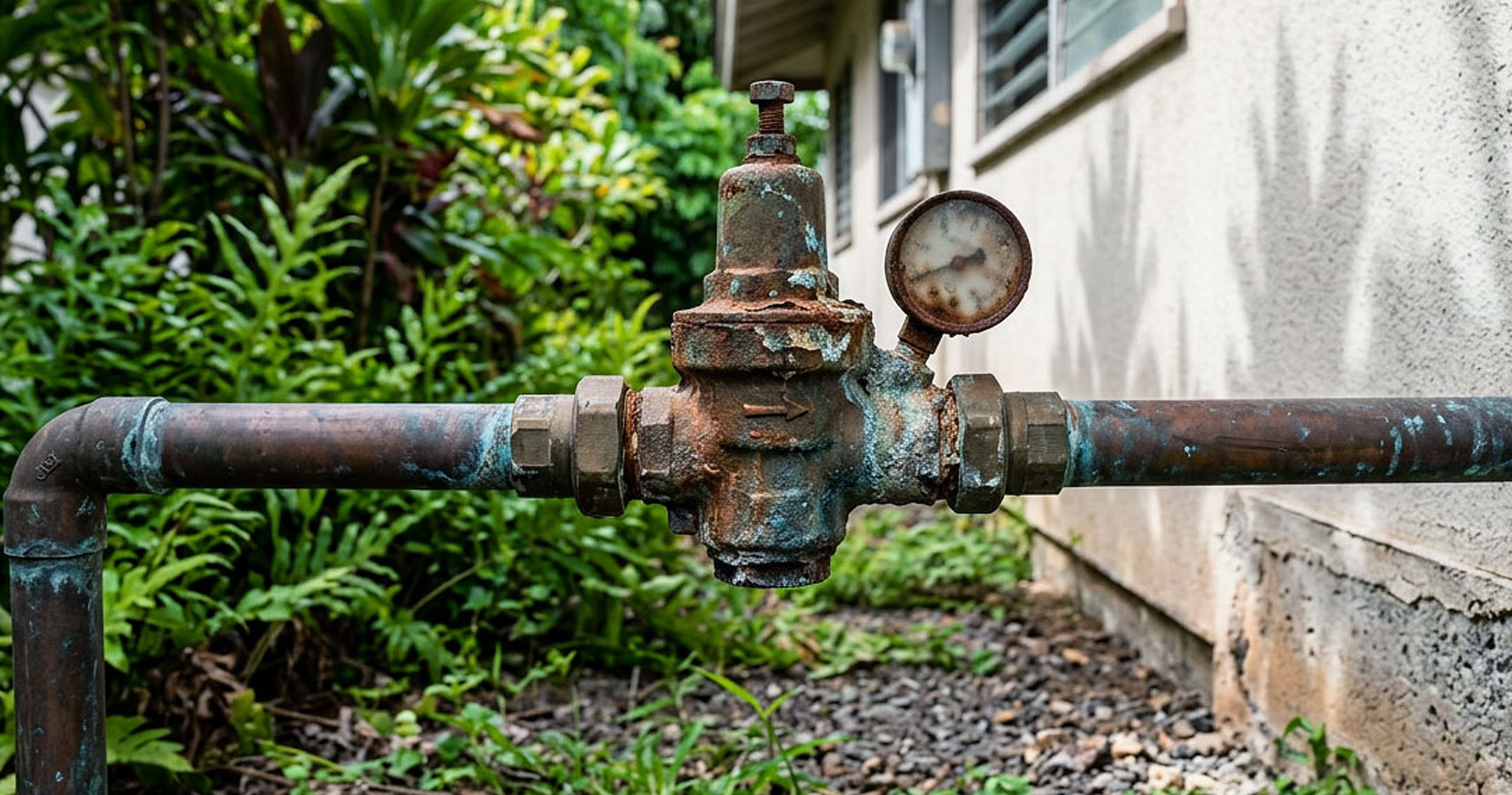
The PRV sits where your main water line enters the home, usually near the meter or at the first accessible point inside. Its job is simple: step that incoming pressure down to a safe range — ideally 40 to 60 psi — and hold it there no matter what the main is doing.
Inside the valve, a spring-loaded diaphragm does the regulating. Water pushes against the diaphragm, and the spring tension controls how much flow gets through and at what pressure. Most valves have an adjustment screw on top so a plumber can dial in the exact setting your home needs.
It’s a mechanical device with moving parts — and like every mechanical device with moving parts, it eventually wears out.
What PSI should home water pressure be?
| Pressure (psi) | What it means |
|---|---|
| 40–60 psi | ✅ Ideal range for residential plumbing |
| 60–80 psi | ⚠️ Acceptable but on the high side — watch it |
| Above 80 psi | ❌ Too high — accelerates wear on pipes, fixtures, and appliances |
| Below 40 psi | ⚠️ Low — uncomfortable flow; may signal a stuck PRV |
You can check your own pressure with an inexpensive gauge from any hardware store — just thread it onto a hose bib and open the water.
Why PRVs Fail Faster on Oahu
On the mainland, a PRV might last 15 to 20 years under favorable conditions. On Oahu, we see them fail at 10 to 12 years — sometimes sooner. Here’s why island homes are harder on them:
| Factor | Mainland | Oahu |
|---|---|---|
| Typical PRV lifespan | 15–20 years | 10–12 years |
| Incoming pressure | Moderate | Often 100+ psi near pumping stations |
| Water chemistry | Varies | Mineral-rich; accelerates internal scale |
| Air environment | Mostly dry/inland | Salt air corrodes housings and fittings |
- High incoming pressure. Homes closer to pumping stations or at lower elevations can see pressures well above 100 psi — significant mechanical stress on the diaphragm, every hour of every day.
- Mineral-rich water. Honolulu’s water is safe to drink, but its mineral content speeds up buildup inside the valve body. Scale can restrict flow, jam the diaphragm, or make the valve stick open or closed.
- Corrosive salt air. Salt air is hard on metal. If your PRV sits in an exterior utility area or a poorly ventilated space — both common in Hawaii homes — the housing and connections can corrode faster than you’d expect.
- Aging housing stock. Many homes we work on in Manoa, Palolo, and Kaimuki were built in the 1950s and ’60s. If a PRV went in during a remodel 15 years ago and nobody’s touched it since, it’s due for attention.
6 Warning Signs Your PRV Is Failing
This is the part most homeowners ask about: how do you know something’s wrong? These are the signals we see most often.
1. Suddenly high water pressure
The most obvious sign. If your showers are blasting, toilet tanks refill faster than usual, or supply lines feel stiff, pressure may have climbed above the safe range. A simple pressure gauge will confirm it — anything consistently above 80 psi is a concern.
2. Low pressure throughout the house
PRVs can fail in both directions. When the diaphragm seizes, it can over-restrict flow and drop pressure below what you need. If low pressure affects every fixture — not just one — the PRV is a likely suspect.
3. Pressure that fluctuates
Good water pressure feels consistent. If your shower cycles between a trickle and a blast, or pressure shifts when someone uses another fixture, the diaphragm may be losing its ability to regulate steadily.
4. Water hammer (banging pipes)
That clunking noise in your walls when you shut off a faucet or the washing machine stops filling? That’s water hammer, and high pressure is a common cause. Pipes aren’t supposed to slam like that — over time it weakens joints and connections.
5. Shortened appliance lifespan
If you’ve replaced a water heater, washing machine, or refrigerator ice maker sooner than expected, check your water pressure. Running appliances above their rated pressure accelerates internal wear.
6. Visible problems at the valve
Mineral crust, corrosion at the fittings, or dampness around the valve body all suggest the PRV needs replacement. A small drip at the adjustment cap isn’t always a crisis, but it warrants a look from a licensed plumber.
How Your PRV Affects Your Water Heater
This one surprises a lot of homeowners: there’s a direct link between your PRV and the life of your water heater.
When a PRV fails and pressure climbs, your water heater’s temperature and pressure relief valve (T&P valve) has to work harder to compensate. If you’ve noticed your T&P valve dripping periodically, high incoming pressure is a common cause. That dripping isn’t just wasteful — it means the valve is opening to release excess pressure, something it was only designed to do in an emergency.
On the flip side, when we replace a failed PRV, we often find the water heater has been under high-pressure stress for a long time. That’s why we recommend a plumbing inspection that looks at the whole system, not just the valve in isolation. On Oahu, where water heater lifespans already run shorter than the mainland average, protecting your heater from unnecessary pressure stress really matters.
Can You Replace a PRV Yourself?
PRV replacement kits are sold at hardware stores. Whether you should replace one yourself is a different question.
The short answer: in most cases, it’s a job for a licensed plumber.
Here’s why. Your PRV is tied directly into the main water supply. Replacing it means shutting off the main, cutting or threading into an existing pipe connection, setting the new valve correctly, and restoring service — all while managing the pressure implications. If the fitting is corroded or the surrounding pipe is weakened (common in older Honolulu homes), what looked like a simple valve swap can quickly become a section repipe.
There’s also calibration. A new PRV has to be set to the right output pressure for your specific home and elevation. Too low and you lose useful pressure throughout the house; too high and you’re right back where you started.
And in Hawaii, permits and code compliance matter. Work on your main water supply typically requires a licensed plumber under State of Hawaii licensing rules. Doing it yourself — or hiring someone unlicensed — can create problems with your homeowner’s insurance and with resale disclosure.
How Long Should a New PRV Last on Oahu?
A quality replacement PRV, properly installed and set to the correct pressure, should give you a solid 10 to 15 years on Oahu. You can extend its life by:
- Scheduling a pressure check during a routine plumbing inspection every few years
- Having the valve inspected if you notice any of the warning signs above
- Checking your water heater’s T&P valve at the same time — they’re related systems
When to Call 535 Plumbing
If you’re seeing any of the warning signs above — high or fluctuating pressure, banging pipes, a water heater dripping at the T&P valve, or simply more than 10 years since anyone looked at your PRV — it’s time for a professional set of eyes.
We’ll check your incoming pressure with a calibrated gauge, inspect the valve and surrounding connections, and give you an honest assessment. No scare tactics. No upselling work you don’t need. If your PRV is fine, we’ll tell you that too.
535 Plumbing has served Oahu since 2015. We work across the island — from Ewa Beach to Kailua, from Mililani to Makiki — and we know the specific pressure and corrosion patterns that affect homes in your area.
📞 Call us at (808) 300-0535. We’re here to help.
Frequently Asked Questions
How do I know if my home has a PRV?
Most homes built or replumbed after the 1980s have one. It’s usually near the water meter — at the exterior wall, in a utility closet, or in the crawlspace — and looks like a bell-shaped or dome-topped metal valve on your main supply line. If you’re not sure, a plumber can locate it during an inspection.
What PSI should my water pressure be?
The sweet spot for residential plumbing is 40–60 psi. Anything consistently above 80 psi wears on pipes, fixtures, and appliances. You can test it yourself with an inexpensive gauge from any hardware store — thread it onto a hose bib and open the water.
Can a failing PRV make my water bill go up?
Yes, indirectly. High pressure increases the flow rate from every fixture, so you use more water per minute of showering, dishwashing, or running the tap. It can also worsen small leaks at fixture connections you might not even notice.
My pressure seemed fine last year. Can a PRV fail suddenly?
It can, though it’s more often a gradual decline. Mineral scale, corrosion, or a cracked diaphragm can reach a tipping point and change performance fairly quickly. That’s why a periodic pressure check matters — it catches trends before they become problems.
Do condos on Oahu have PRVs?
It depends on the building. Many mid- and high-rise buildings in Kakaʻako and Waikiki regulate pressure at the building level through a centralized system, so individual units may or may not have their own PRV. If you’re having pressure issues in a condo, your building engineer is a good first call — and we can help diagnose what’s happening at the unit level.
Why Choose 535 Plumbing
We’re not just a service company — we’re your neighbors. We know Oahu’s plumbing codes, water chemistry, and the corrosion patterns specific to your zip code. From CIPP lining and trenchless sewer line repair in Hawaii to tankless water heater installation and routine residential work, we bring commercial-grade expertise to every home.
Schedule an inspection or call us to talk through your situation. We’re here to help!
Membership Programs Bring Peace Of Mind
Aloha Membership Preventive Plumbing Maintenance
Our Aloha Membership is designed for homeowners who want year-round peace of mind. It includes routine plumbing inspections and maintenance that help catch issues early — before rainy season turns them into emergencies. Preventive care is one of the best ways to avoid unexpected plumbing repairs.
Annual Backflow Inspection Membership
535 Plumbing’s Annual Backflow Inspection Membership ensures regular testing and inspection of your backflow devices, preventing contaminants from entering the potable water supply and protecting your family’s health. It helps identify and repair issues before they lead to costly system failures or water contamination events.
Annual Tankless Water Heater Maintenance Membership
Our Annual Tankless Water Heater Maintenance Membership ensures regular testing and inspection of your tankless water heater, removing scale buildup, ensuring a reliable supply of heated water, and preventing costly repairs and extending the unit’s lifespan.
All Membership Plans include:
- 10% off on all services, up to $600.
- Service coordination fees waives, a $139 savings on every service visit.
- Priority Scheduling, placing you at the top of the list.
Let us help you prepare, protect, and prevent plumbing problems before they cause greater damage and larger repair costs.
Why Local Experience Matters
Plumbing in Hawaiʻi is different from plumbing on the mainland. Our soil, weather, tree growth, and older infrastructure create unique challenges. That’s why working with a local plumbing company that understands Hawaiʻi conditions makes a big difference.
At 535 Plumbing, we’ve helped homeowners across the islands deal with plumbing issues for years. We don’t believe in scare tactics — we believe in honest inspections, clear explanations, and solutions that make sense for your home and budget.
Start the new year with confidence. Call (808) 300-0535 to schedule your plumbing inspection today. Hiring a licensed plumber ensures the job is done correctly and up to code.
Call 535 Plumbing for Expert Advice
Whether you choose to repair or remodel, 535 Plumbing can help you make the right decision for your home and budget. We provide honest recommendations, professional installation, and access to high-quality appliances designed for island life.
Get a Professional Quote for Your Plumbing Emergency
535 Plumbing specializes in plumbing inspections, repairs, complete remodels, trenchless pipe repair and much more. Whether you need a routine cleaning or a complex repair, we provide expert plumbing services tailored to your specific situation. Contact us today for a professional assessment and a customized quote to keep your plumbing system in top shape!
535 Plumbing is here to help. We offer:
- Fast and Reliable Service: Get prompt assistance when you need it most.
- Expert Technicians: Our skilled plumbers have experience with all garbage disposal types and plumbing systems.
- Upfront Pricing: No surprises—just honest, transparent estimates.
- Sustainable Solutions: We fix garbage disposals efficiently to save water and reduce your environmental footprint.
Schedule an inspection and take the first step toward reclaiming control over your plumbing. If you live on O‘ahu and are in need of a licensed plumber to help with your plumbing issues, choose 535 Plumbing for the job! Our team of professional O‘ahu plumbers are highly skilled and our excellent customer support representatives will work with you to schedule your appointments at a time you most convenient. Learn more and schedule an appointment by calling (808) 300-0535, or Visit Our Contact Us Page.
We have the tools and expertise to diagnose and resolve your plumbing issue efficiently. Don’t let a simple plumbing problem escalate—take action today to maintain the functionality of your home’s plumbing system. For more plumbing maintenance tips and advice, check out our other guides. Mahalo!